You sit down, and the seat shifts. You stand up, and it slams shut without warning. A broken or misbehaving Kohler toilet seat is more than a minor annoyance, it can genuinely disrupt the flow of your household. Kohler toilets are known for their precision engineering, but even the best fixtures need a little maintenance to keep that polished feel. The good news is you likely do not need a plumber or expensive replacement parts to solve this problem.
Learning how to fix a Kohler toilet seat is usually a ten-minute project that requires nothing more than a screwdriver and a little patience. Kohler uses some unique mounting hardware compared to other brands, specifically their quick-release and grip-tight systems. If you treat these like a standard toilet seat, you might damage the hinges. This guide will walk you through the distinct mechanisms, from the standard bumpers to the advanced quick-attach models.
We will diagnose the wobble, fix the soft-close mechanism, and replace broken anchors so your bathroom feels stable and quiet again. Before you spend money on a new unit, let us tighten, adjust, and restore the one you have using the correct techniques for Kohler’s specific designs.
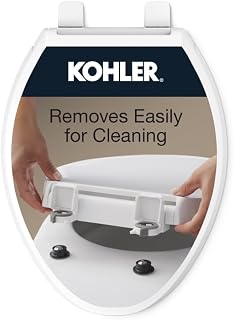
KOHLER 4636-RL-0 Cachet ReadyLatch Elongated Toilet Seat Slow Close, Soft Close Toilet Seat Quiet Lid, Contoured Grip-Tight Bumpers Installation Hardware, Apartment Essentials, White
Check PriceUnderstanding Your Kohler Toilet Seat Mechanism
Before you grab a tool, you must identify exactly which mounting system you are dealing with. Unlike generic seats, Kohler uses proprietary hardware that hides the bolts for a seamless look. The most common systems are the standard plastic anchors, the Grip-Tight rubber expansion system, and the Quick-Release hinges. Mistaking one for the other often leads to stripped threads or cracked hinges, because the connection point differs significantly from a traditional bolt-and-nut setup.
Identifying Standard vs. Quick-Release Hinges
Standard Kohler seats feature a metal bolt that passes directly through the bowl and secures with a plastic wing nut underneath. The cap on top is purely cosmetic and snaps off to reveal the screw head. The quick-release system, however, looks entirely different. You will see a rectangular or circular button on the back of the hinge. When you press this button, the entire seat lifts vertically off a docking station that remains bolted to the toilet.
- Standard Mount: A round, flat cap covering a Phillips-head screw. No visible buttons.
- Quick-Release: A visible thumb tab or push-button located at the hinge post.
- Grip-Tight: A plastic cylinder that spins to wedge itself inside the mounting hole, no access needed underneath the bowl.
Common Reasons for Seat Malfunctions
Most issues boil down to three culprits: loosened hardware, broken plastic anchors, or a malfunctioning damper. The seat base is subjected to lateral pressure every time you sit, which slowly unscrews loose bolts or cracks brittle plastic components. Dirt and mineral buildup inside the hinge housing can also stop the soft-close feature or prevent the quick-release button from locking back down. Fortunately, replacing the rubber bumpers or tightening the wedge anchors usually restores stability instantly.
How to Fix a Loose or Wobbly Kohler Toilet Seat
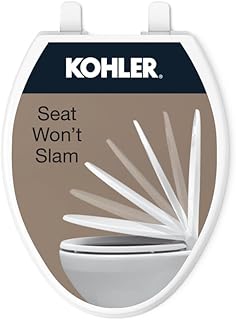
KOHLER Brevia Slow Close Elongated Toilet Seat, White | 20110-0, Grip-Tight Bumpers, Quiet Close, Quick-Attach Hardware
Check PriceA sliding seat feels cheap and unstable, regardless of how high-end the porcelain is. The fix depends entirely on whether your bolts thread from the top or anchor from the bottom. If you have access under the bowl, the repair is straightforward, but for skirted toilets or Grip-Tight systems, you must work exclusively from above. Let us stabilize that rocking motion step by step.
Tightening Standard Hinge Bolts
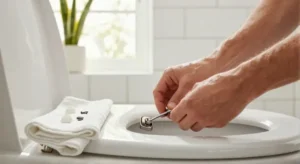
Start by popping open the small plastic caps at the back of the hinges using a flathead screwdriver. Do not force them from the side, insert the tip from the front or back recess. Underneath, you will find a Phillips-head screw. Hold the large plastic wing nut underneath the bowl with your hand to stop it from spinning. Turn the screw on top clockwise to tighten. Be firm but gentle, over-tightening metal into plastic strips the threads instantly.
If the nut keeps spinning and will not snug up, the plastic threads inside the anchor have likely failed. This requires a complete seat replacement or new anchors. Once the bolt feels snug, snap the decorative cap back down. Test the seat by sitting and shifting your weight. A correctly tightened seat should feel bonded to the bowl with zero lateral play.
Servicing the Grip-Tight and Quick-Attach Hardware
The Grip-Tight system does not use a nut underneath the bowl. Instead, a plastic threaded cylinder squeezes a rubber grommet, expanding it against the sides of the hole. To tighten this, completely remove the seat by pressing the release buttons, and lift the shell away. You will see the docking posts remaining on the rim. Inside that dock, you will see a screw head. Spin the screw clockwise slowly. The rubber wedge underneath the ceramic will expand and bite into the porcelain, eliminating slack.
If the dock itself is spinning, the rubber grommet has probably hardened or cracked. You need to pull the entire anchor out and install a new Kohler replacement kit. This process is similar to what you would find when fixing a loose seat on non-Kohler brands, but Kohler’s tolerance is tighter, so always use authentic Kohler anchors. Using a generic insert will wiggle from day one.
Fixing a Kohler Soft-Close or Slamming Lid
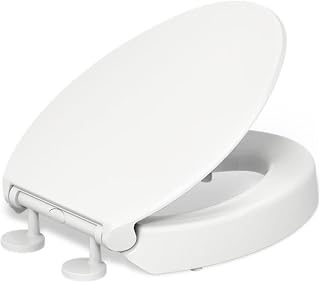
KOHLER Hyten 3″ Height Solft Close Elongated Toilet Seat, White | 25875-0, Elevated Contoured Seat, Grip-Tight Bumpers, Quick-Attach Hardware
Check PriceThe quiet-close feature is a luxury until it fails, letting the lid slam down audibly in the middle of the night. The mechanism relies on a hydraulic damper inside the hinge. This damper is filled with viscous fluid that resists gravity. When the lid drops like a rock, it usually means the fluid has leaked out, the hinge has bound up, or the plastic linkage inside the seat post has cracked.
Adjusting Damper Resistance on Quick-Release Seats
There is no external adjustment screw for speed control on Kohler dampers, but you can check the alignment. Remove the seat fully using the quick-release buttons. Look at the metal pin inside the docking station. It must be perfectly straight. If it is bent even slightly, the damper cartridge inside the seat ring cannot rotate freely. Straighten it carefully with needle-nose pliers.
Clean the dock on both the bowl side and the seat side with a damp microfiber cloth. Sticky residue acts like a brake pad, causing the seat to stop mid-fall before slamming down. Apply a tiny dab of silicone plumbing grease to the metal pin. Petroleum jelly can degrade the plastic over time, so stick with silicone. Slide the seat back on until it clicks audibly. The soft-close motion should immediately feel smoother.
Replacing Broken Bumpers and Buffer Pads
The rubber bumpers on the bottom of the seat play a critical role in how the lid lands. When these fall out or dry up, the plastic lid contacts bare ceramic, cracking the ring over time and causing a loud noise. Kohler sells bumper replacement packs specific to their models. To swap them, look at the underside of the ring. Pop the old, yellowed bumper out with a flathead screwdriver. Press the new rubber cone firmly into the hole until the lip flattens against the surface.
A missing front-center bumper is often the hidden culprit behind a cracked seat. Always check the very front edge. If the seat closes unevenly, check that all bumpers are identical in height. Mixing aftermarket bumpers with original ones can tilt the ring, putting extreme torque on one hinge while overcompressing the damper on the other.
How to Remove a Stuck Kohler Toilet Seat
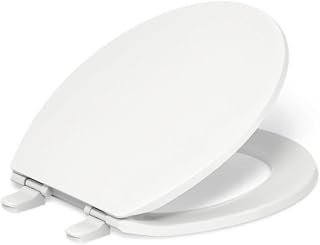
KOHLER 20111-0 Brevia, Slow Close Toilet Seat, Round Toilet Seat, Grip-Tight Bumpers Quick-Attach Hardware, White
Check PriceSometimes the problem is not a wobble, but a seat that refuses to budge for cleaning or replacement. Calcium deposits from hard water weld the plastic dock to the ceramic rim. Corroded bolts inside standard anchors can also fuse solidly. Yanking on the seat risks chipping the toilet bowl, which is a permanent disaster. You need a safe chemical and mechanical approach to break the bond without breaking the china.
Breaking Stubborn Hard Water Bonds
Pour white vinegar directly onto the gap between the plastic dock and the porcelain. Let it soak for twenty minutes. The acidity dissolves the calcium lattice holding the two together. If you notice blue-green crusted buildup, that is oxidized copper from corroded brass inserts, CLR cleaner works faster than vinegar here. After soaking, tap the hinge housing gently with a rubber mallet or the wooden handle of a hammer. The vibration shatters the mineral crystals, loosening the grip.
Never use a metal hammer directly on the plastic, as it will shatter the hinge body. For standard metal bolts that are seized, spray a penetrating lubricant like PB Blaster onto the screw head threads under the cap. Let it wick down into the anchor for ten minutes before turning. This is the most reliable method for removing a rusted bolt without shearing the head off.
Safe Techniques for Skirted Toilets
A skirted toilet has a smooth, concealed trapway, meaning you cannot reach your hand underneath to unthread a conventional nut. If you are dealing with a Kohler skirted one-piece, the seat is absolutely a top-mount or quick-release model. Look for a tiny set screw on the side of the docking station. Use an Allen wrench to back that set screw out entirely. Once the screw is out, the docking station should slide straight up. If it resists, the rubber wedge is stuck inside the hole.
Thread the mounting bolt back into the top of the dock, but only halfway down. Lift the dock slightly and pull the bolt upward with a wiggling motion. This compresses the rubber inward, reducing friction. Once the rubber cone collapses enough, the whole unit lifts out cleanly. This technique preserves the factory hole size and prevents chipping around the rim.
Preventative Maintenance for Long-Lasting Stability
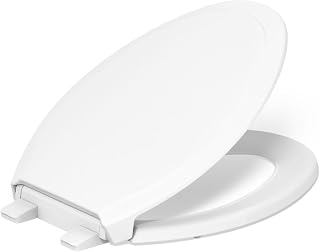
KOHLER 4734-RL-0 Rutledge ReadyLatch Soft Close Elongated Toilet Seat, Quiet-Close Lid Grip-Tight Bumpers, Installation Hardware, Home Essentials, White
Check PriceToilet seats live in a harsh environment of moisture, ammonia, and temperature swings. A quick quarterly check-up stops annoying noises before the hardware fails completely. Prevention takes less than sixty seconds per toilet and dramatically extends the life of the hinges. You should focus on cleanliness, torque, and lubrication.
- Clean the Urine Gap: Lift the seat and wipe the space between the dock and the porcelain. Urine crystals build up invisibly and push the anchor sideways.
- Reapply Silicone Grease: Pop off quick-release seats quarterly. Re-lube the metal post. This keeps the damper fluid from overheating due to friction.
- Check Tightness Seasonally: Humidity swells plastic, dry air shrinks it. A seat tight in winter might wobble in summer. Give the screws a quarter-turn check.
- Replace Bumpers Annually: Rubber bumpers cost very little. Replacing them every year ensures the lid never contacts the ceramic rim directly, preserving the glaze.
Following these basic steps reduces the stress on the anchoring points. When you handle high-end Kohler replacement seats, the factory grease is often sparse. Supplementing it during installation prevents the vast majority of early slamming failures.
Troubleshooting Specific Damper and Quick-Release Failures
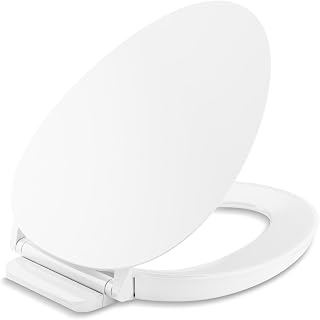
KOHLER 57777-WCF-0 Cymbal ReadyLatch Quiet-Close Soft Close Toilet Seat Elongated, Flexible CoreFlex Material, Wider Toilet Seat Surface, Home Essentials, White
Check PriceSometimes the seat clicks in but still falls fast, or the lid falls correctly while the ring does not. A dual-damper imbalance is common in elongated models. The two hinges must move in perfect synchronization, or one damper fights the other, leading to a jerky descent. This section addresses those fine-tuning scenarios.
Fixing One-Sided Soft-Close Failure
If the left side slows down but the right side drops, the right damper has likely lost its fluid internally. You can test this by removing the seat and pressing on each metal pin individually. A working damper pin feels stiff and moves slowly when pushed. A blown damper pin offers zero resistance. There is no way to refill the viscoelastic fluid yourself, the cartridge is ultrasonically welded shut.
Purchase a genuine Kohler hinge kit rather than a whole new seat. The hinge kit includes both damper cartridges and the pins. Slide the old cartridge out of the seat plastic slot and snap the new one in. Ensure the orientation matches the L and R marking on the plastic. Swapping them reverses the damping direction and causes immediate binding.
Re-Engaging a Jammed Quick-Release Button
A button that stays pressed in and will not lock onto the dock usually has an obstructed spring or a worn plastic catch. Remove the seat fully. Look inside the hollow post of the seat ring. You will see a curved metal spring clip. If lint and hair wrap around this clip, it cannot snap back onto the docking pin. Use tweezers to pull the debris out.
Press the button repeatedly to check springback. If the spring is broken, you will feel no push-back force. The spring clip is part of the hinge assembly, so you must extract the cartridge to replace it. Do not attempt to glue the seat to the dock, as this traps bacteria and makes cleaning impossible. A properly functioning button should snap down with a confident, sharp click.
Replacing Cracked Plastic Kohler Anchors
The weakest link in the entire setup is the white plastic anchor sleeve sitting inside the porcelain hole. After years of shear stress, a hairline crack propagates down the threads. You will recognize this failure because the screw tightens, spins, and loosens again endlessly, like a stripped bolt. Leaving it like this oblongs the hole in the toilet, making future repairs much harder.
Extracting Expired Split Anchors
Push the damaged anchor down through the hole so it falls onto the floor under the toilet. If it is stuck, insert a flathead screwdriver from above and tap it firmly until the plastic breaks away. For skirted bowls where through-holes are absent, you must grip the anchor lip with needle-nose pliers and pull it upward while rotating. A drywall screw threaded lightly into the plastic can give you the grip needed to pull it straight up.
Clean the rim hole thoroughly with a disinfecting wipe. Any grit left behind will crack the new anchor instantly upon insertion. Dry the ceramic completely with a paper towel before snapping the new Kohler anchor into place. This dry-fit prevents moisture from turning into limescale under pressure.
Installing the Correct Factory Kit
Kohler sells anchor kits by the toilet model number. Check the instruction booklet for your specific model, usually found inside the tank lid. The generic hardware store kits use a weaker glass-filled nylon that expands at a different rate. When you insert the genuine Kohler anchor, align the flat sides of the flange with the flat sides of the bowl hole. Press it down firmly until the lip sits flush with zero wobble. Thread the bolt in by hand initially to avoid cross-threading.
Once secure, install the hinged seat and tighten the bolt from above, following the torque guidance for your hinge type. A correctly installed anchor should provide a rigid, immovable base, as described in the manufacturer’s guidelines from Kohler’s official seat specifications. This small step distinguishes a professional fix from a temporary patch.
Cleaning and Lubrication Secrets for Seamless Function
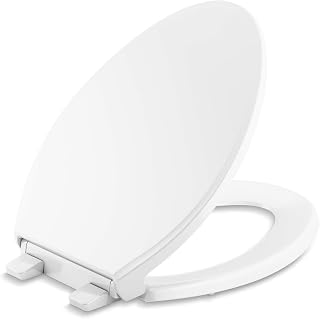
KOHLER 24295-0 Figure ReadyLatch Elongated Toilet Seat, Quiet-Close Lid and Seat, Countoured Seat, Grip-Tight Bumpers and Installation Hardware, White
Check PriceMany problems labeled as mechanical failures are simply hygiene issues. Harsh bowl cleaners containing bleach seep into the hinge housings and crystallize. This abrasive powder grinds the plastic bushings down. Changing your cleaning habits can add five years to a Kohler seat’s lifespan without replacing a single part.
- Avoid Spraying the Hinges: Never spray bathroom cleaner directly onto the hinge caps. The mist carries solvents into the damper grease, thinning it.
- Use Dry Lubricant: For standard metal hinges, a dry PTFE spray lubricant repels moisture. Wet grease traps dust and turns into grinding paste.
- Rinse After Acid Washes: If you use a pumice stone or acid-based cleaner on the rim, rinse the bolt caps heavily. Residual acid migrates down the bolt threads and embrittles the plastic nuts.
A gentle approach keeps the soft-close mechanism feeling hydraulic rather than jerky. The goal of fixing a wobbly seat is to restore that silent, solid feel you expect from a premium Kohler bathroom.
Frequently Asked Questions About Kohler Toilet Seat Repair
Why does my Kohler toilet seat keep loosening every few weeks?
Recurring loosening almost always points to a stripped plastic anchor or a missing rubber grommet inside a Grip-Tight system. The rubber bottom plug provides the constant outward pressure that locks the screw threads via friction. If that plug is gone, vibration walks the screw loose rapidly. Replace the full anchor assembly rather than re-tightening the stripped threads repeatedly.
Can I fix a Kohler soft-close seat that falls too fast?
Yes, but only if the damper mechanism is dirty or dry, not blown. Remove the seat and clean the metal connecting posts thoroughly. Re-lubricate them with silicone grease and reseat the ring. If the resistance is still zero, the internal damper cartridge has failed and must be replaced. This is a modular fix, you do not need to buy a whole new seat ring.
How do I remove a Kohler toilet seat with no visible bolts?
Your seat uses the Quick-Release or Grip-Tight top-mount system. Look for a rectangular button on the back of the hinge. Press both buttons simultaneously and lift the seat straight up. If there are no buttons, look for a small Allen set screw on the side of the docking station housing, marking a Grip-Tight base that requires unthreading before extracting.
Is it safe to use WD-40 on my Kohler seat hinges?
While WD-40 is excellent for breaking rusty bolt bonds, it is too thin for long-term lubrication and can degrade certain plastics and rubber dampers. Use it only to free a stuck screw, then wipe it off completely. White lithium grease or pure silicone grease should be your standard lubricants for the moving parts. Avoid penetrating oils directly on the soft-close cartridge.
Can I replace Kohler bumpers with generic stick-on pads?
Generic stick-on felt or rubber pads provide a quick fix but fail within months due to moisture exposure. They compress unevenly and throw off the lid alignment, leading to hinge stress. The genuine molded Kohler bumpers click into a specific recess, keeping the ring parallel to the bowl. Spend the small amount on the factory bumper kit for a lasting repair.
Conclusion
Knowing how to fix a Kohler toilet seat gives you control over the tranquil, silent function of your bathroom. These mechanisms are not complicated once you look past the hidden hinges and understand the rubber wedge or quick-release logic. Whether you are eliminating a nerve-racking wobble or restoring the whisper-quiet descent of a soft-close lid, the solution lives in the anchor points and the damper pins.
Start by correctly identifying your hinge type, using the right tools for extraction, and cleaning the oxides that plague porcelain connections. A small investment in silicone grease and genuine Kohler bumpers will yield years of rock-solid service. Do not suffer through a shifting seat, grab a screwdriver, lift the caps, and lock everything down properly. Your bathroom deserves that factory-fresh, stable feel right now.